
Shaping a Museum: The Enduring Legacy of Karen Johnson Boyd
Over the course of several decades, Karen Johnson Boyd (1924–2016) played a defining role in shaping the identity and collection of the Racine Art Museum (RAM). Through her sustained support as a collector and donor, she helped transform a growing regional institution into one of the most significant repositories of contemporary craft in North America. Her impact was not defined by a single gift alone, but by a long-term commitment to artists, materials, and the belief that contemporary craft and works on paper deserve enduring institutional attention.
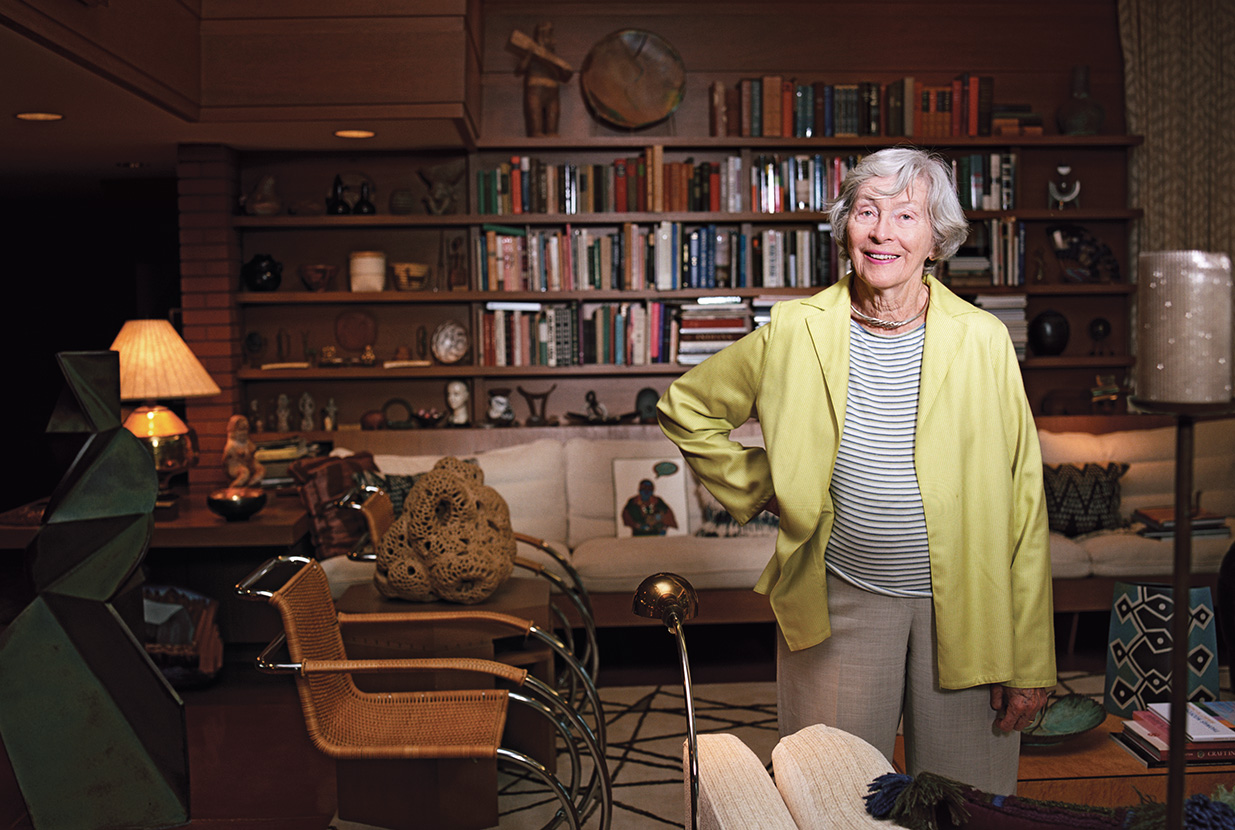
Boyd was born in Racine in 1924 into a family deeply connected to industry, design, and cultural patronage. Growing up in an environment shaped in part by her family’s leadership of SC Johnson, she was exposed early to the intersection of architecture, innovation, and artistic vision. That sensibility was reinforced by her education in art history and studio art, including studies at Bennington College, where she began to develop a sustained interest in collecting and supporting contemporary artists.
Her engagement with contemporary art deepened through exposure to major exhibitions and collections associated with SC Johnson in the 1960s, which presented both painting and craft at a high level of ambition and visibility. These experiences helped solidify her belief that artists working in a range of media—from ceramics and fiber to painting and printmaking—were part of a shared creative continuum. From that point forward, she approached collecting not as accumulation, but as a form of advocacy.
Boyd began collecting in earnest in the mid-20th century, but her collecting practice became more focused and influential over time. She was drawn particularly to artists working in contemporary American craft, as well as works on paper, and she often collected in depth rather than broadly, acquiring multiple works by individual artists in order to support a fuller understanding of their practice. This approach reflected a consistent interest in artistic development over time rather than isolated moments of achievement.
Her relationship with RAM evolved gradually, beginning with early donations in the 1970s and developing into one of the most significant philanthropic partnerships in the museum’s history. In 1991, she made a transformative gift of approximately 200 artworks that immediately elevated the museum’s profile and strengthened its curatorial focus on contemporary craft. Over the following decades, her total contributions would grow to nearly 1,700 objects, making her the museum’s largest single donor.
What distinguished Boyd’s impact was not only the scale of her giving, but also its coherence. Her gifts reflected a highly developed collecting philosophy that emphasized continuity, material exploration, and sustained attention to artists’ careers. Rather than treating works as isolated acquisitions, she helped build a collection in which objects speak to one another across time, medium, and context. This approach became foundational to RAM’s evolving identity as a museum of contemporary craft.
In 1982, Boyd extended her influence beyond collecting by founding Perimeter Gallery in Chicago. The gallery became an important platform for contemporary art, known for its commitment to presenting artists working across media and for its willingness to place craft, painting, and works on paper in direct dialogue. Through this work, she helped expand opportunities for artists while reinforcing the idea that material boundaries in contemporary art were fluid rather than fixed.
Boyd’s relationship with RAM also had a catalytic effect on the museum’s growth. Her generosity helped attract additional donors and collectors, while reinforcing the institution’s emerging reputation as a national leader in contemporary craft. As the collection expanded, so too did its ambition, eventually becoming the largest museum collection of contemporary craft in North America and a defining feature of RAM’s identity.
Today, her legacy is embedded throughout the museum’s collection and curatorial vision. The works she gave continue to shape how audiences experience contemporary craft at RAM—through depth, dialogue, and an enduring commitment to material-based practice. In recognition of her extraordinary contributions, the museum dedicated its galleries in her honor, ensuring that her role in shaping RAM remains visible not only in its holdings, but in its ongoing mission.