
OBJECTS: USA: How SC Johnson Impacted Contemporary Craft
In October 1969, OBJECTS: USA opened at the (then) Smithsonian National Collection of Fine Arts in Washington, D.C., launching a new chapter in contemporary craft. With over 300 objects on display, a marketing campaign meant to generate interest across the American public, and sponsorship by a significant American company, SC Johnson, the project was designed to make an impact.
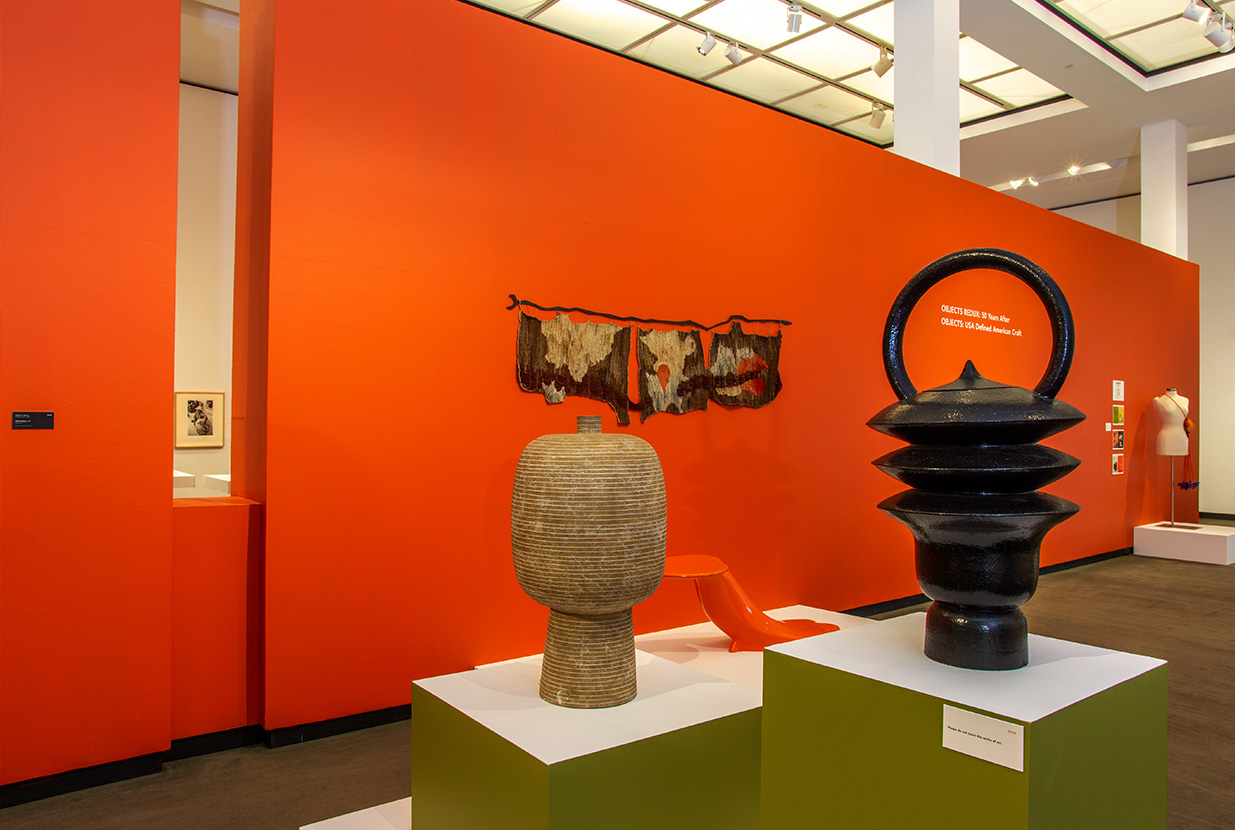
Marking the 50th anniversary of this landmark event in 2019, Racine Art Museum (RAM) and the Houston Center for Contemporary Craft hosted simultaneous exhibitions that traced this watershed moment for the field. Rather than a remote historical occurrence, OBJECTS: USA linked Racine, sometimes indirectly, to percolating critical dialogues on national and international stages. It highlighted that there were people and organizations in Racine who were willing to put the time and energy into promoting conversations about creativity and the power of art. SC Johnson alone sponsored two projects in the 1960s — Art USA Now (1962) and OBJECTS: USA (1969) — that gathered together artwork that was exhibited in multiple locations, featured in a book, and subsequently gifted to organizations around the country.
OBJECTS: USA, really the presentation of a collection assembled for SC Johnson by art dealer Lee Nordness and then Museum of Contemporary Crafts (now known as Museum of Arts and Design) director Paul Smith, showcased “the American object maker.” In the late 1960s, as society was undergoing social upheaval, studio craft in the United States was pushing boundaries in terms of influences, subjects, scale and scope, intent, and material exploration. On some level, studio craft shifts marked societal shifts and the handmade object and its maker marked a tactility, passion, and intimacy that stood in response to mass-production, machines, and disposability. The issues and concerns that were impacting artists’ daily lives were impacting the work they produced and the context in which it would be shown.
Accompanied by a substantial book with images and artist biographies, as well as a sales catalog titled arts/objects: usa and an hour-long movie, a combination of over 300 works made of so-called craft materials made its way to over 20 U.S. and 14 international venues on its multi-year tour. Before being disassembled in the way of gifts to several institutions, OBJECTS: USA introduced a broader public to the possibilities of media most often associated with function not intellectual, aesthetic, or material investigations and offered a new way for understanding those works and their makers. Institutions reported record-breaking attendance and positive newspaper reviews emphasized the quality, tone, and sophistication of the work – as well as its capacity to, in these opinions, shed new light on craft.
In 2019, RAM used objects to tell a vibrant story that linked people and places, past and present. For example, one of RAM’s most recognizable collection pieces, the silver leaf-topped Desk by Wendell Castle, given to RAM by SC Johnson in 1991, was also one of the most notable works on the OBJECTS:USA tour. RAM’s single largest artwork donor, Karen Johnson Boyd, who grew up in Racine with a family devoted to art, architecture, and innovation, purchased numerous pieces from the related sales catalog, ultimately gifting those works to RAM. While the Museum of Arts and Design in New York received the largest number of gifted works from OBJECTS: USA, the artwork situated in collections around Racine tells a much richer story that weaves together art, craft, creativity, family, place, and commerce. The 2019 exhibition at RAM was a one-of-a kind combination of artwork, comprised of things that had not been shown together before—pieces that came to Racine at the end of the OBJECTS: USA tour and works acquired from the arts/objects: usa catalog. Works from RAM were shown with over 35 pieces borrowed from SC Johnson, Prairie School, Carthage College, and the Johnson Foundation.
Objects Redux showcased the type of work that raised big questions about what was being created 30–50 years ago, by whom, and for whom. While it punctuates an era that has seen craft’s presence rise in fine art museums and encouraged a larger conversation about what the word “craft” could mean, it also reminds us that these discussions are not linear paths but more interconnected threads.