
John Dillinger, Warrington Colescott, and RAM
Did you know that the Racine Art Museum (RAM) has a link to historical true crime?
The footprint of the current RAM Downtown building incorporates the renovation of two historical structures that date back to the 1870s. In the 1930s, one of those two buildings was the home of the American Bank and Trust Company of Racine. It is famous in local history for the daring daylight holdup carried out at the bank by John Dillinger—aka “Public Enemy No. 1.”—and his gang on November 20, 1933. Partly because people were downtrodden and feeling disenfranchised by authority and capitalist society, Dillinger, who was colorful, theatrical, and “larger than life,” was often compared to Robin Hood. The public stayed enraptured with his exploits as radio and media carried all the headlines on what he and his gang were doing, while simultaneously exaggerating his bravado and charming persona.
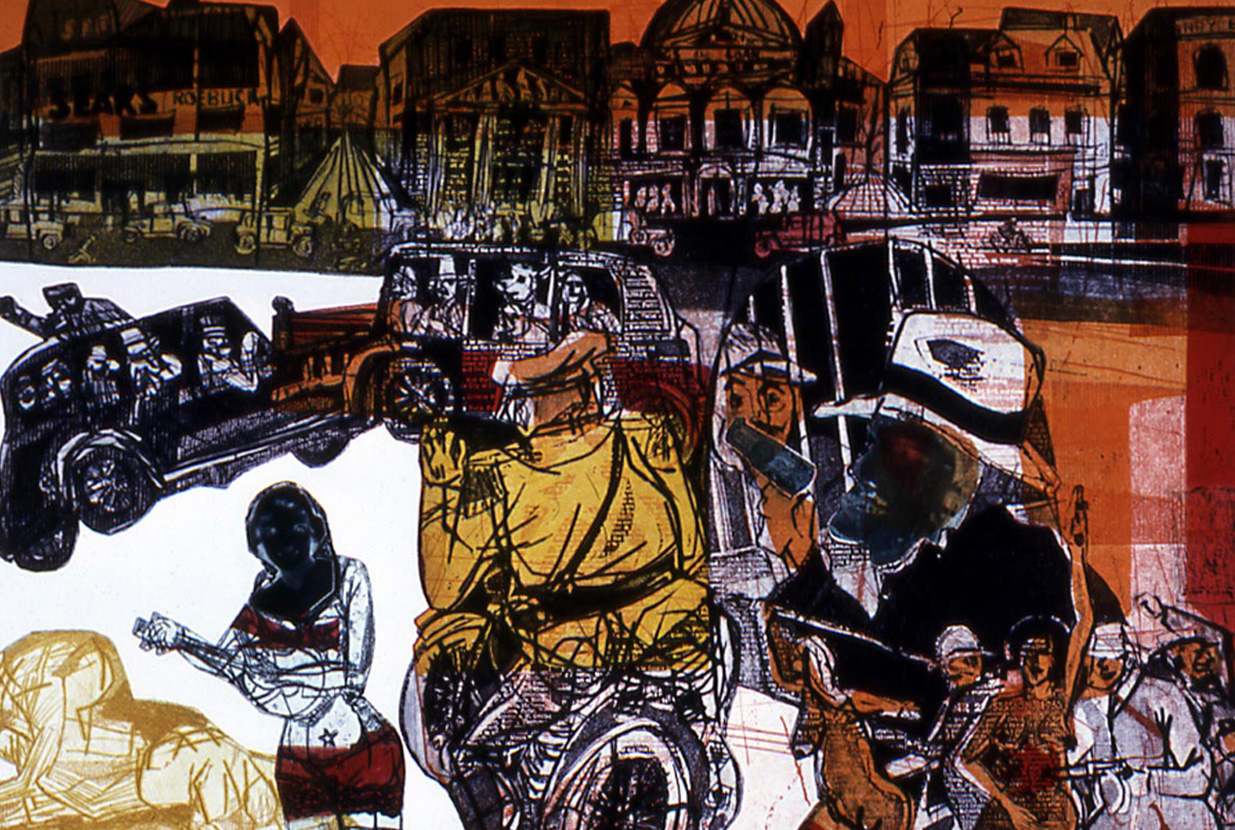
Evading police gunfire, Dillinger and his gang escaped the Racine robbery with $27,700 (over $700,000 today) and four hostages, who were later released unharmed. While it is not accessible to the public, the vault of the bank is still intact in the basement area of the museum. (Basically, a small room with a heavy old door, it is not as glamorous as the bank vaults in movies). Further reinforcing this link to Dillinger, the museum was given a suite of prints by Warrington Colescott that address the bank robber’s exploits during the Great Depression of the 1930s in the United States.
Following in centuries-old traditions of satirical printmakers, Colescott created prints, drawings, and watercolors that reflected his quick wit and pointed observations about modern society. With a style rooted in realism and accepting of the slightly fantastical, Colescott took on civil rights, history, politics, John Dillinger, and the IRS, to name a few subjects, in his 70-year career. Encouraged by colleagues at the University of Wisconsin-Madison who were interested in folklore and himself drawn to stories and figures of popular interest and societal issues, Colescott focused on the celebrity and violence that were a part of the Dillinger story, as well as the social justice system of the 1930s. Prints created between 1964–1974 depict various Dillinger gang bank robberies, Dillinger’s prison escapes, the shoot-out with the FBI at Little Bohemia Lodge in northern Wisconsin, and Dillinger’s death at a theater in Illinois. Like all of Colescott’s work, these pieces blend fact and fiction, further adding to the legend of the bank robber.
Colescott’s prints are not on permanent display at RAM but are shown in the galleries on occasion. Interested parties can see an artifact from the robbery on view at the Racine Police Department – a Colt Thompson submachine gun taken from a wounded police officer during the robbery. Recovered by authorities in Arizona, Dillinger had signed his name on it with a wood-burning tool. The gun was returned to the police who have had it on public display for many years.
The John Dillinger connection to Racine is rooted in place, artifacts, and artistic imaginings. When he created his Dillinger series, Warrington Colescott couldn’t have known that his work would one day be so closely linked to one of the scenes of the bank robber’s crimes.