
Creative Gestures: Generations of Artists Build the Wustum Campus
What has kept the Racine Art Museum (RAM) Wustum campus a vibrant presence in the community for over 80 years?
In 1938, Jennie E. Wustum donated her house, property, and a small trust fund to the City of Racine to establish an art museum and park in memory of her husband, Charles. The Charles A. Wustum Museum of Fine Arts (also known as RAM Wustum) was founded on November 16, 1941. Since then, the historic property has not just survived, but thrived as part of RAM’s broader arts organization.
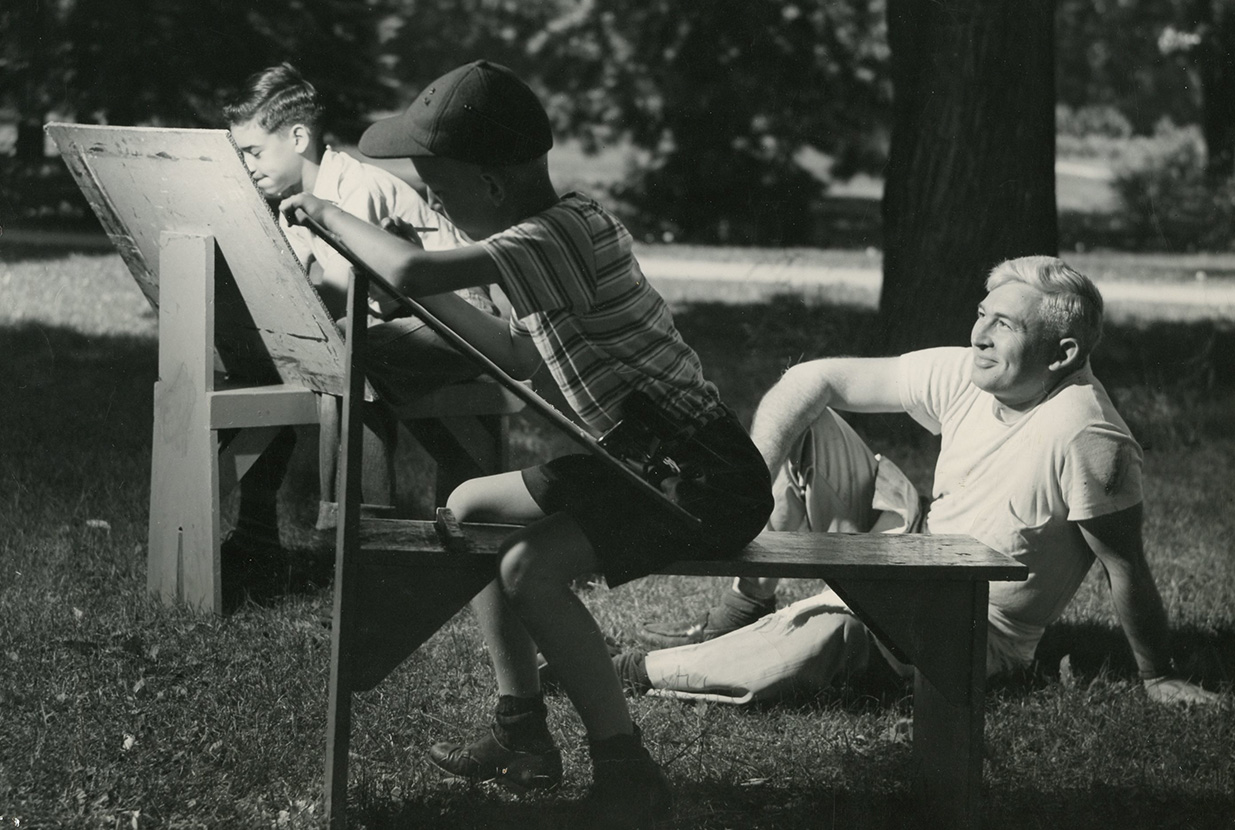
RAM Wustum’s first Director, Sylvester Jerry, and his family lived on the property (it is a house at its core after all!) in the 1940s and 1950s. Jerry, a practicing artist, and his wife, Cherry Barr Jerry, were instrumental in developing the strong network of people who were the organization’s earliest advocates, instructors, and leaders. Barr Jerry herself taught adult and children’s art classes in watercolor, drawing, enameling, lapidary, bookbinding, papermaking, and creative stitching techniques at RAM Wustum. Both Jerrys continued their affiliation with the museum throughout their lives.
While the “first family” of RAM Wustum, the Jerrys could not singlehandedly build the foundation needed to sustain and foster the longstanding interest in the arts that propelled the Wustum campus through the years. Other early proponents included artists such as Byron Gere (1898–1961) and Richard J. Jensen (1916–1990), who made Racine their home and who became teachers at RAM Wustum and/or members of the organization’s Board of Directors. Instrumental to the hiring of Sylvester Jerry, area educator Helen Sawyer (1891–1969) taught in public schools for over 40 years and heavily influenced young people who became professional artists and were active in the local scene, such as Robert Burkert (1930–2019) and Sherman Groenke (1915–2008).
While the initial focus was not on building a collection, in the 1940s RAM Wustum received a major gift from the Works Progress Administration (WPA), including prints, paintings, drawings, and textiles by contemporary artists. In 1966, it added a wing for studio art classes and organized the first Watercolor Wisconsin, a statewide watercolor competition that continues to this day. The museum began building its contemporary craft collection in the 1970s, thanks to ongoing donations from longtime patron Karen Johnson Boyd, an American Craft Council trustee and owner of Perimeter Gallery in Chicago. These moments highlight institutional milestones that tell a part of Wustum’s story—another significant part is told through the many and various people who have contributed time and effort to the organization over the years.
When the downtown museum (now known as RAM Downtown) came into existence in 2003 as an outgrowth of the Wustum campus, the role of the artist in institutional development necessarily expanded in need and scope. Artists who have played important roles at both campuses have done so not just as working artists, but also as teachers, donors, board members, volunteers, committee members, staff, activists, catalysts for large gifts, benefactors, and donors of significant archives. Their artworks have been included in various exhibitions over the years, including several that directly highlighted the creative force orbiting Wustum, including 1998’s The Creative Years at Wustum and Wustum Generations on display at RAM Downtown in 2017. Significantly, many have artworks in the collection—with several being represented by more than one piece.
For decades, RAM Wustum has both embraced and been embraced by members of the Racine community—offering exhibitions, classes, and workshops; hosting special events, including weddings on its scenic and inspiring grounds; and generally acting as an artistic beacon for the region. This was strengthened by the long-term leadership tenure of Bruce W. Pepich, who simultaneously advocated for contemporary artists and built a collection that includes North America’s largest holding of contemporary craft.
Involving working artists — both from the area and beyond — in planning and executing all manner of programs and cultivating fundamental relationships has ensured that both campuses—RAM Wustum and RAM Downtown—remain vital resources and attractions.